
I’ve always been drawn to this mystical world — a place tucked high in the Himalayas between two giants, India and China, so hidden and so different from our Western way of life. I was endlessly curious about what daily life actually looks like somewhere people hold so much respect for each other, for nature, so much genuine kindness. When the invitation came from my favorite Southeast Asia supplier, I didn’t hesitate for a second. Ten days in Bhutan changed something in me. Hands down, it’s the best trip of my life so far, and I don’t say that lightly.
Getting There Is Part of the Story
Bhutan has one international airport, Paro (PBH), famous for one of the most spectacular landings in the world. Only two airlines are permitted to fly into the country — Drukair and Bhutan Airlines — no other carrier operates the route. They connect through Bangkok, Kathmandu, New Delhi, Kolkata, Dhaka, and Singapore, so travelers from North America, Europe, or Australia will need a connection through one of these hubs.
I had never seen an airport that tiny. It fit the country perfectly: Bhutan is home to roughly 800,000 people in total, making it one of the smallest nations I’ve ever visited. Traditional farmhouses and ancient dzongs dotted the valley below, and the warmth of the people, dressed in ghos and kiras, was immediate. Waiting for us just past the terminal was the man who’d be with us for all ten days, and he became something closer to a wise friend than an escort — it was through his wisdom, his unconditional love and pride for his country, that Bhutan’s layers slowly opened up to me.
Before You Go: The Visa and the Sustainable Development Fee
Bhutan isn’t a country you book on a whim. Every international visitor needs a visa arranged in advance through a licensed Bhutanese tour operator — there’s no visa-on-arrival, and no way to apply independently. The visa itself carries a one-time, non-refundable fee of about $40, and the clearance letter typically comes back within about a week.
The bigger line item is the Sustainable Development Fee, or SDF: roughly $100 per adult, per night, for most nationalities (regional visitors from India, Bangladesh, and the Maldives pay a much lower rate). Children under 6 are exempt, and those between 6 and 12 pay half. This fee sits apart from your hotel, meals, guide, and transport, which are arranged separately.
What makes the SDF worth understanding, rather than just budgeting for, is where the money goes. It directly funds free education and healthcare for Bhutanese citizens, along with environmental conservation and cultural preservation — the pillars of Bhutan’s “high value, low volume” approach to tourism. Every night I spent in the country was, in a very literal sense, a contribution to a Bhutanese child’s schooling or a family’s access to a doctor. Knowing that changed how I felt before I’d even landed — knowing exactly where that money goes already gave me a genuinely good feeling, like I was giving back just by being there — and it’s a detail I now share with every client who asks why Bhutan isn’t a bargain destination. It was never meant to be.
A Country Measured in Happiness, Not GDP
Beyond the scenery and the monasteries, there’s a philosophy at the heart of Bhutan that changes how you see everything else. Bhutan measures its progress through Gross National Happiness, prioritizing collective well-being over pure economic growth. It shows up everywhere: in how the land is protected, in how culture is preserved, in how government decisions get made.
This isn’t a marketing line for tourists. It’s a genuine belief in karma and interconnectedness that shapes daily life, and being immersed in it for ten days quietly rearranged something in me. The people I met carried a kind of contentment that had nothing to do with material accumulation — homes were modest, needs were simple, and nobody seemed to be chasing more for the sake of it. There’s a real cultural discomfort with greed here, rooted in Buddhist teaching: the idea that clinging to wealth or status only creates suffering, for yourself and the karmic chain around you. I found myself measuring my own life against that standard more than once, usually at moments I least expected it.
That same worldview extends outward to the land itself. Mountains, rivers, and forests aren’t resources to the Bhutanese; they’re regarded as living, sentient parts of a shared existence. My guide spoke about rivers the way you’d speak about an elder relative — with a mix of respect and quiet responsibility. Bhutan is constitutionally required to maintain at least 60% forest cover, and it shows: this is one of the only carbon-negative countries on Earth, a fact that felt less like a statistic and more like a lived value once I was standing in the middle of it, surrounded by silence and pine.
Paro: Where the Journey Begins
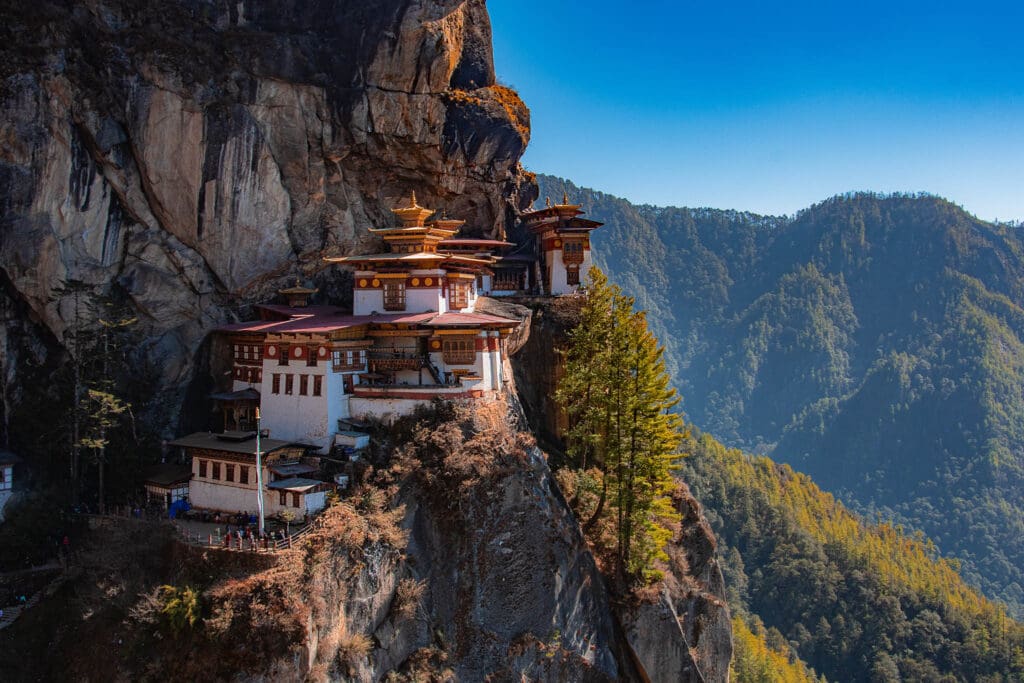
Paro is the gateway to Bhutan, and its valley — a mix of emerald rice terraces, farmhouses, and centuries-old temples — sets the tone for everything that follows. One of the most fascinating parts of Paro, though, is the hike to Paro Taktsang, the Tiger’s Nest Monastery — often named among the wonders of the world. It was, hands down, the most challenging hike I’ve ever done, and also one of the most rewarding.
Calling it a hike undersells it. The trail climbs through pine forest, and with each switchback, the monastery comes into clearer view, seemingly built into the cliff face itself.
Punakha: A Closer Look at Monastic Life
From Paro, the road leads to Punakha — warmer, lower in elevation, and home to Bhutan’s former capital. Punakha Dzong sits at the meeting point of the Pho Chhu and Mo Chhu rivers, and it’s every bit as commanding as that setting suggests: whitewashed walls, intricate woodwork, a cantilever bridge for an entrance, and a courtyard scaled for awe.
Gangtey: Where the Cranes Return
The final stop was Gangtey Valley, a wide, glacial expanse that feels like its own world. Every winter, black-necked cranes migrate here from Tibet, a living symbol of how seriously Bhutan takes conservation. The grasslands roll on for miles, and the air thins just enough to remind you how high up you are.
Gangtey Monastery sits above it all, home to monks whose days are shaped by chanting and meditation. This is where the trip stopped being about buildings and started being about people. I watched young monks, some no older than seven or eight, move through their studies and chores with a discipline that humbled me — up before sunrise, hours of chanting and scripture. My guide arranged a private conversation with one of the senior monks, who walked me through what a day in the monastery actually looks like: prayer, education, farming, community service, repeated in a rhythm that’s held for centuries. I had endless questions — what it takes to become a monk, why a family sends a child at that age, what they give up and what they gain. I didn’t want that conversation to end.
I sat in on evening prayers, uninvited to participate but welcomed to observe, and the sound of dozens of low voices chanting in unison is something I still hear when I close my eyes.
What Stayed With Me
I knew Bhutan would be an exceptional trip. I never thought it would have such a deep effect on me. Ten days taught me more about intention, restraint, and genuine happiness than any trip before it, and I came home a slightly different person than the one who left.
Bhutan isn’t hidden from the world so much as it has chosen, deliberately, to protect what matters most to it. I’m deeply grateful I got to see that up close, and I haven’t stopped thinking about it since.
Even now, when people ask me what Bhutan was really like, I still tear up trying to explain it — some things are just hard to put into words. Ten days were not enough — I left a piece of my heart in those mountains, and I know I have to go back.


